
Business value
How business valuation shapes your capital options
Why the same company is worth different amounts to different readers, and which value blockers are worth closing before the next stage.
The Gravity teamGravity Business Consulting4 min read
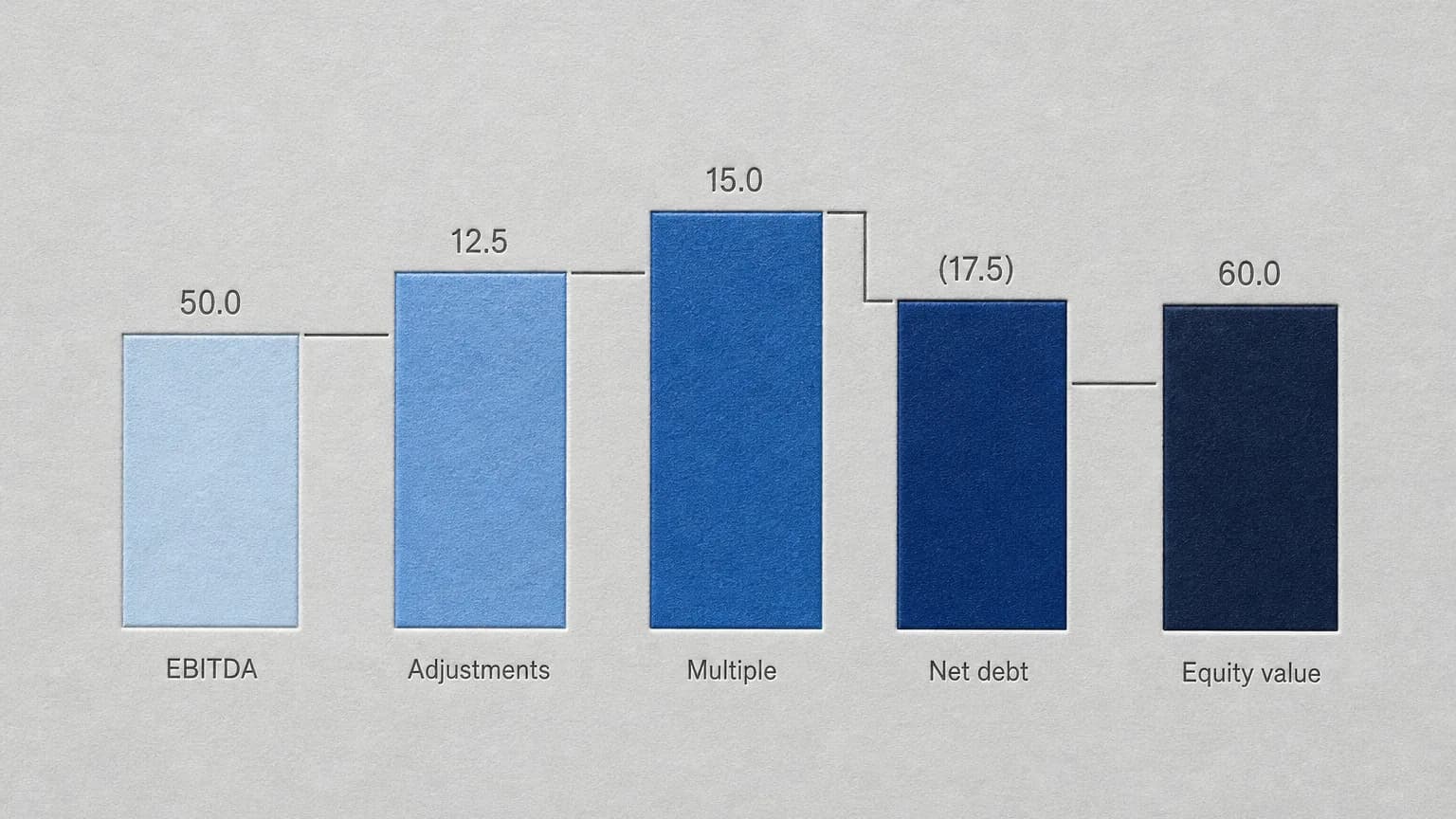
Owners usually meet valuation as an exit question, and treat it as something to think about later. It is doing work long before that. The same characteristics that determine what a business is worth to a buyer determine what a lender will advance against it, what an investor will pay for a minority position, and what terms either will attach.
Understanding why the same company is worth different amounts to different readers is more useful than arriving at a single number.
There is no single value, and that is not a technicality
A business has a different value to a strategic acquirer, a financial buyer, a minority investor, and a lender sizing a facility, because each is buying a different thing. The strategic buyer is buying a position and can pay for synergies it will realise. The financial buyer is buying cash flows and a return over a hold period. The lender is not buying the business at all — it is sizing what can be repaid under stress.
This is why a valuation quoted at a conference or produced by an online calculator is close to useless for planning. The question worth asking is not what the business is worth, but what characteristic of the business is currently limiting what it is worth to the specific reader that matters next.
Value drivers and value blockers
Every valuation approach eventually resolves to the same two variables: how much cash the business produces, and how confident the reader is that it will keep producing it. The first is arithmetic. The second is the whole game, and it is where owner-led businesses lose most of their value.
The characteristics that most often compress the multiple, in rough order of how frequently they appear:
- Owner dependence. Relationships, pricing decisions, technical knowledge, and sales concentrated in the owner. A buyer is acquiring a business that changes materially the day the owner leaves.
- Customer concentration. A small number of accounts carrying a large share of revenue. Disclosed, contracted, and diversifying, it is a known risk; undisclosed, it is a discount.
- Unreliable financial information. If the numbers cannot be trusted without extensive verification, the reader discounts for the uncertainty and prices the cost of finding out.
- Undocumented process. Operations that work because particular people know how they work. Nothing transfers, so nothing can be underwritten as continuing.
- Volatile or unexplained margins. Movement that management cannot attribute to a cause reads as a business that is not understood by the people running it.
How this reaches the capital conversation
The link is direct. A lender's advance rate, covenant package, and pricing all reflect its assessment of durability — the same assessment a buyer makes. An equity investor's price and control terms reflect it too, and more sharply, because the investor is holding the risk rather than sitting ahead of it.
So the value blockers above are not exit-planning items to address in five years. They are the reason a facility comes back smaller than expected, or with a personal guarantee attached, or with reporting covenants that feel disproportionate to the size of the loan.
Which blockers are worth closing first
Not all of them repay attention equally, and the honest answer is company-specific. Two principles hold generally.
The first: close the blockers that are cheap to close and expensive to leave. Reliable, timely financial information is usually the clearest example — it is a process problem rather than a strategic one, and it sits underneath every other assessment a reader makes.
The second: address the structural blockers early, because they take the longest. Reducing owner dependence or diversifying a concentrated customer base is measured in years, not quarters. A company that starts that work when a transaction or a financing is already in motion has started it too late to affect the outcome.
The reason to know the number anyway
None of this argues against understanding current value. It argues against treating the number as the output. The number's usefulness is as a baseline: it establishes where the business stands today so that the effect of closing a specific blocker can be estimated, prioritised, and then observed.
Used that way, valuation stops being a question about the eventual sale and becomes a planning instrument for the next three years — which is the period in which most capital decisions are actually made.
The Gravity Capital Readiness Analysis looks at financial, operating, and valuation blockers together, because they are the same set of facts read by different audiences. Formal valuation and formal exit planning are separate, specialist engagements with their own scope and providers. Gravity does not raise capital, place capital, or broker transactions, and each provider makes its own underwriting and approval decision.
Where to take this next
The application determines whether a company advances to a qualification call and, if qualified, the Gravity Capital Readiness Analysis.