
Forecasting
The financial forecast every growth plan needs
What a defensible forecast contains — the drivers behind it, the scenarios around it, and the cash view that shows what happens before it happens.
The Gravity teamGravity Business Consulting4 min read
Most owner-led businesses have something they call a forecast. It is usually last year plus a percentage, built once a year, and consulted rarely. It is not wrong so much as inert — it cannot be argued with, learned from, or used to make a decision in March.
A forecast that carries a growth plan is a different instrument. It is built from drivers, it has scenarios around it, it shows cash rather than only profit, and it is compared to reality often enough to improve.
Drivers, not a growth rate
The single most important property of a defensible forecast is that the revenue line is built up rather than assumed. Volume, price, mix, capacity, sales headcount, conversion, churn, and lead time are the variables the business actually operates on, and the forecast should be a function of them.
This matters for two reasons that have nothing to do with financing. A driver-based model tells you which lever to pull when the plan is behind, and it tells you what has to be true for the plan to work — which is often the moment an owner discovers that the plan requires hiring at a rate the business has never achieved.
It also happens to be what makes the forecast readable to an outside party. A reader can disagree with an assumption. A reader cannot do anything with a percentage.
Scenarios, and why the downside is the important one
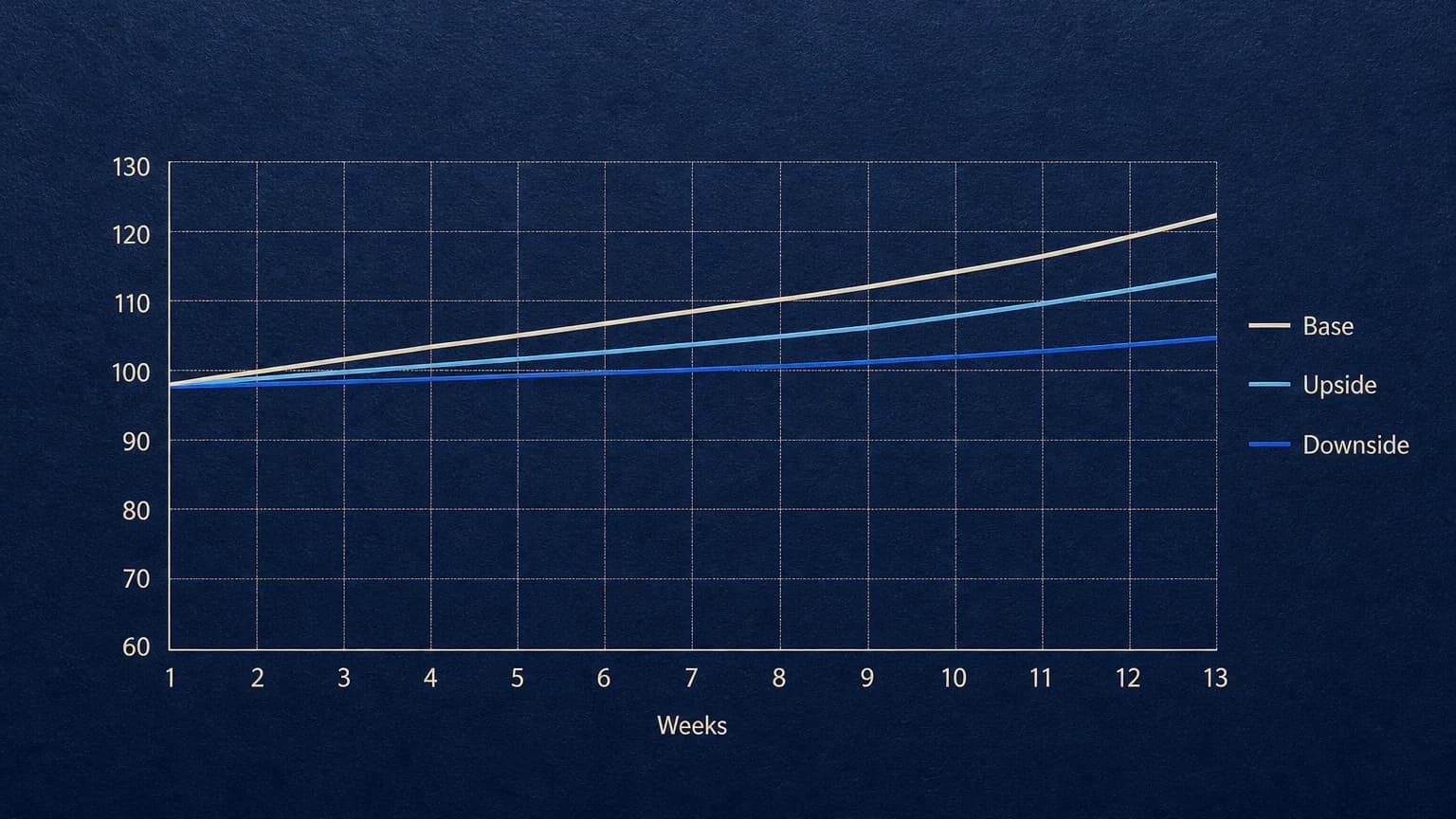
A single-line forecast asks its reader to accept one future. Three cases — a base, an upside, and a genuine downside — ask a better question: under what conditions does this still work?
The downside case does the most work and is the one most often skipped. It should be specific rather than a uniform haircut: what happens if the largest customer does not renew, if the hire is three months late, if input costs move against the business, if collection slows. The value is not the number at the bottom. It is that management has already decided what it would do.
The cash view is not the profit view
Profitable companies run out of cash routinely, and growth is one of the most reliable ways to do it. Receivables stretch, inventory builds ahead of demand, payroll steps up before the revenue does, and the profit-and-loss statement reports a good quarter throughout.
A near-term cash plan — Gravity works to a rolling thirteen-week view — answers a question the annual budget cannot: what does the bank balance do between now and the end of the quarter, week by week, under each scenario. It is the single most useful artefact a growing business can maintain, and the one whose absence is most visible to a provider.
Rolling, not annual
An annual forecast is stale by the second quarter and abandoned by the third. A rolling twelve-month forecast, re-cut monthly against actuals, stays useful all year and produces something the annual version never does: a track record.
That track record is disproportionately valuable in a capital conversation. A company that can show twelve months of forecast-versus-actual, with the variances explained, has demonstrated forecasting capability rather than asserted it. That is a materially stronger position than a fresh model produced for the occasion, however sophisticated.
What good looks like in practice
The test is not complexity. Elaborate models built by people who no longer work at the company are a common failure mode, and a simple model the management team can operate beats a sophisticated one nobody can update.
A forecast is doing its job when all of the following are true.
- The person presenting it can explain any assumption in it without opening the file.
- It is re-cut on a fixed cadence against actuals, and variances are discussed rather than absorbed.
- It produces a cash view, not only a profit view.
- It carries a downside case that management has actually reasoned through.
- It drives decisions — hiring, pricing, capital expenditure — rather than being produced after them.
Building the forecast is ordinary work with an unusual property: it improves the way the business is run and the way it is evaluated at the same time. Installing that discipline — the rolling forecast, the thirteen-week cash plan, the driver and KPI view behind them — is a substantial part of what a Gravity engagement puts in place.
Where to take this next
The application determines whether a company advances to a qualification call and, if qualified, the Gravity Capital Readiness Analysis.